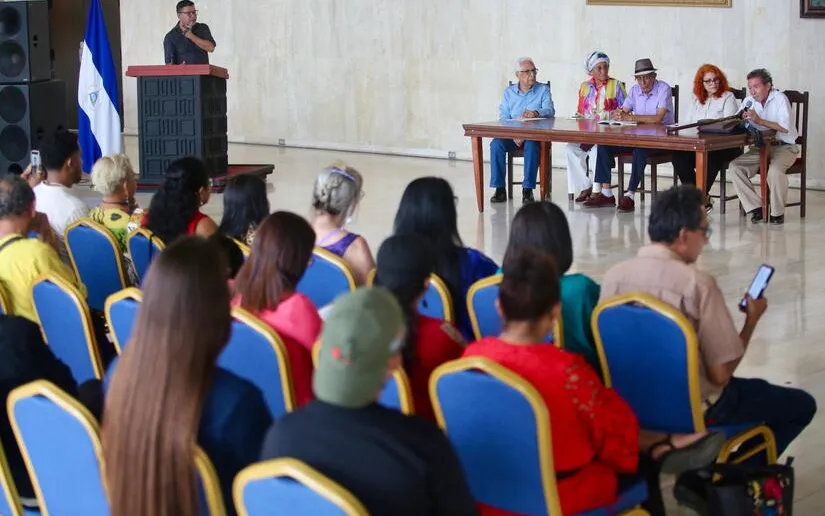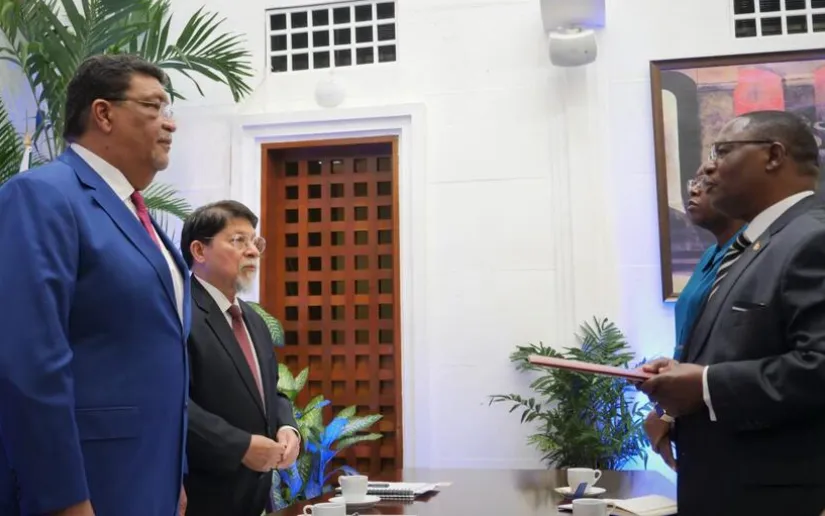








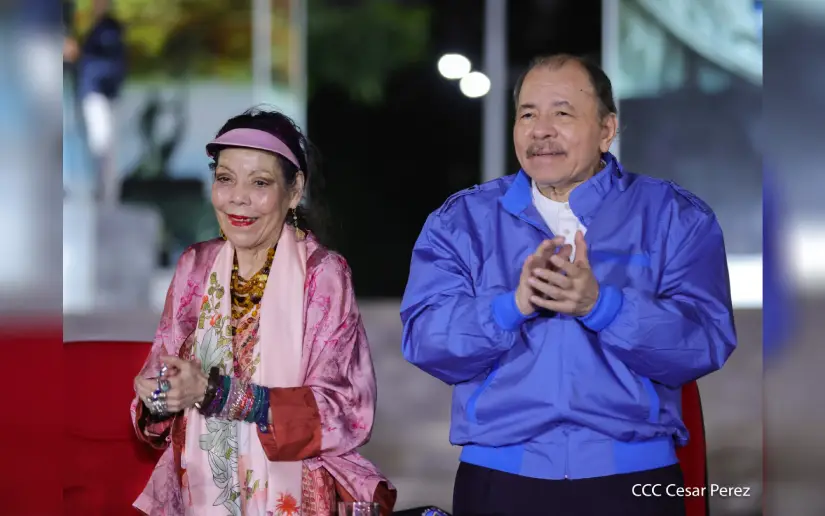
Acto de Entrega de
Medalla de Reconciliación y Paz
“Cardenal Miguel”
9 de Febrero del 2026
Palabras del Doctor Gustavo Porras
Presidente de la Asamblea Nacional
Buena tardes, este 9 de Febrero, cuando cumplimos un Aniversario más del Tránsito a la Inmortalidad del Coronel Santo López, Eslabón Vital entre el Ejército Defensor de la Soberanía Nacional y el Frente Sandinista de Liberación Nacional; Eslabón Vital entre Sandino y Daniel.
Buenas tardes, estimado Comandante Daniel, Copresidente de la República; Compañera Rosario Murillo, Copresidenta de la República.
Nuestro Saludo a Don Jaime Morales Carazo, ex Vicepresidente de la República, y a Doña Amparo Vásquez de Morales, su Esposa, su Compañera, su Amiga.
Buenas tardes, Compañera Arling Alonso, Vicepresidenta de la Asamblea Nacional; Compañera Darling Hernández, Compañeros y Compañeras, Juventud, Jóvenes. Buenas tardes, Jóvenes de Nicaragua.
Nos hemos reunido para rendir Homenaje al Espíritu de Reconciliación y Paz, que ha impulsado con firmeza nuestro Gobierno de Reconciliación y Unidad Nacional, nuestro Frente Sandinista de Liberación Nacional, bajo la guía y conducción de nuestros Líderes, Daniel y Rosario.
Nos unimos y nos reconciliamos alrededor de los intereses y aspiraciones de las Familias nicaragüenses. Todo nuestro actuar, todas nuestras acciones, deben estar subordinados a la Alegría, al Bienestar y a la Felicidad del Pueblo de Nicaragua; Hombres, Mujeres, Niños, Niñas, Presente, Futuro y Eternidad de nuestra Patria y nuestra Revolución.
La Reconciliación es alrededor de los intereses y la satisfacción de las necesidades de las Familias nicaragüenses; nuestra Reconciliación es para garantizar la Paz. Paz con Alegría. Paz con Dignidad. Paz con Seguridad, y Seguridad para garantizar la Paz. Paz con Justicia Social, y Justicia Social para garantizar la Paz.
Todos ellos elementos necesarios para alcanzar el objetivo de todos y todas: ¡Derrotar la Pobreza!
Estimados Hermanos y Hermanas, hemos recibido de parte de la Presidencia de la República, de parte del Comandante Daniel Ortega, Copresidente de la República y la Compañera Rosario Murillo, Copresidenta de la República, la decisión de otorgar a Don Jaime Morales Carazo, ex Vicepresidente de la República, la Orden Independencia Cultural Rubén Darío y la Medalla de Reconciliación y Paz “Cardenal Miguel Obando y Bravo”, reconociendo sus Méritos como ejemplo de la Cultura de Reconciliación y Paz del Pueblo y el Estado nicaragüense.
Asimismo, otorgarle a Doña Amparo Vásquez de Morales, en nombre del Pueblo Presidente, junto a Don Jaime, la Medalla de Reconciliación y Paz “Cardenal Miguel Obando y Bravo”, como muestra de la Unión por la Alegría, la Hermandad y el Bienestar de todas las Familias nicaragüenses, especialmente las Mujeres de todas las edades, y las Madres y las Jefas de Hogar, que comparten con ella Fuerza y Espiritualidad, garantías de Vida con Esperanza.
¡Viva la Paz!
¡Viva Daniel!
¡Viva Rosario!
Gracias, Hermanos y Hermanas. Un abrazo.
Procederemos a leer el Acuerdo Presidencial No. 24-2026
“La Co-Presidencia de la República de Nicaragua, Copresidente Daniel Ortega y Copresidenta Rosario Murillo,
CONSIDERANDO :
Que Don Jaime Morales Carazo és un Eminente Ciudadano que representa la Cultura de Reconciliación y Paz que debe caracterizarnos, y en estos Días de Conmemoración del Príncipe de las Letras Castellanas, Rubén Darío, y de Celebración
del Centenario del Cardenal Miguel Obando y Bravo, Pastor de la Reconciliación y la Paz;
Ha decidido otorgar a Don Jaime Morales Carazo, ex Vicepresidente de la República, reconociendo sus Méritos como Ejemplo Magnífico de la Cultura de Reconciliación y Paz del Pueblo y el Estado nicaragüenses, la Orden de la Independencia Cultural Rubén Darío y la Medalla de Reconciliación y Paz “Cardenal Miguel Obando y Bravo”;
Por tanto, en uso de las facultades que le confiere la Constitución Política,
ACUERDAN :
Artículo 1: Otorgar la Orden de la Independencia Cultural Rubén Darío y la Medalla de Reconciliación y Paz “Cardenal Miguel Obando y Bravo”, a Don Jaime Morales Carazo, ex Vicepresidente de la República, reconociendo sus Méritos como Ejemplo Magnífico de la Cultura de Reconciliación y Paz del Pueblo y el Estado nicaragüenses.
Artículo 2: El presente Acuerdo surte su efecto a partir de esta fecha. Publíquese en La Gaceta, Diario Oficial.
Dado en la Ciudad de Managua, República de Nicaragua, el 9 de Febrero del Año 2026, a 100 Años del Nacimiento del Cardenal Miguel Obando y Bravo, y 110 Años del Tránsito a la Inmortalidad del Gran Rubén Darío.
Daniel Ortega Saavedra,
Copresidente de la República de Nicaragua
Rosario Murillo Zambrana,
Copresidenta de la República de Nicaragua”.
Daremos lectura al Acuerdo Presidencial No. 25-2026.
“La Co-Presidencia de la República de Nicaragua, Copresidente Daniel Ortega y Copresidenta Rosario Murillo,
CONSIDERANDO :
Que Doña Amparo Vásquez de Morales ha sido fiel y noble Compañera del ex Vice-Presidente Jaime Morales Carazo, en todas las circunstancias y momentos de su Vida, compartiendo los Caminos de Reconciliación y Paz que le han caracterizado;
Que Doña Amparo Vásquez de Morales se ha distinguido por su carácter y fortaleza para enfrentar las horas difíciles y siempre transitar las Sendas de Convivencia, haciendo realidad nuestra Cultura de Paz, Reconciliación y Bien Común;
Por tanto, en uso de las facultades que le confiere la Constitución Política,
ACUERDAN, en nombre del Pueblo Presidente :
Artículo 1: Otorgarle, junto a Don Jaime, la Primera Medalla de Reconciliación y Paz “Cardenal Miguel Obando y Bravo”, como muestra de la Unión por la Alegría, la Hermandad y el Bienestar de todas las Familias nicaragüenses, especialmente las Mujeres de todas las edades, y las Madres y Jefas de Hogar, que comparten con ella Fuerza y Espiritualidad, garantías de Vida con Esperanza.
Artículo 2: El presente Acuerdo surte sus efectos a partir de esta fecha. Publíquese en La Gaceta, Diario Oficial.
Dado en la Ciudad de Managua, Casa de Gobierno, República de Nicaragua, el día 9 de Febrero del Año 2026.
Daniel Ortega Saavedra
Co-Presidente de la República de Nicaragua
Rosario Murillo Zambrana
Co-Presidenta de la República de Nicaragua”
Palabras de Don Jaime Morales Carazo
en entrega de Medalla de Reconciliación y Paz
“Cardenal Miguel”
Quiero saludar con verdadero afecto y reconocimiento, a dos queridísimos amigos, que con su Cariño y Confianza nos han honrado siempre. Amparo que vino desde México, y que dice que nació en México pero que renació en Nicaragua.
Ese es un dicho muy lindo del Padre Ángel Martínez, un gran Poeta nicaragüense, eso lo vive repitiendo Amparo desde hace rato, porque así se siente nicaragüense, desde que vino.
Quiero expresar en público nuestro Respeto y afecto fraterno por un queridísimo amigo, el Presidente Ortega y para Rosario, dos grandes Dirigentes de Centroamérica, que han venido aportando todos sus esfuerzos por la mejoría de nuestro Pueblo.
A ellos debemos Paz, que ha sido uno de los objetivos fundamentales del Comandante, y en el cual en muchos aspectos contribuí yo a ayudarle cuando fui Jefe negociador entre la guerra, entre la Contra y el Frente. Guerra infortunada.
Desgraciadamente, no negociamos, no hablamos, que hablando y negociando se evitan esas cosas, pero aprendimos muchísimas lecciones, a no volverlas a repetir nunca pudiéndolas arreglar.
En ese proceso tan difícil y doloroso, el Cardenal Miguel Obando y Bravo jugó un papel fundamental con su Prudencia, con su Paciencia.
Recuerdo que cuando los ánimos se encendían, en todas negociaciones ocurren, él decía, muchachos, no creen que está haciendo mucho calor, aunque estuviera haciendo un enorme frío en la montaña, y que salgamos a tomarnos un refresquito, y con eso se refrescaban los ánimos y seguíamos negociando.
Un gran Maestro de toda confianza para todos fue. Recuerdo que una vez lo visitamos juntos con el Comandante, estuvimos conversando varios ratos con él, y siempre claro, siempre afectuoso, siempre amistoso para el Comandante, para Rosario, y para todos los que estábamos colaborando en ese tiempo directamente.
Yo quiero, precisamente hoy, recordar y no olvidarlo nunca, porque fue un negociador de la Paz, de muchísimos otros problemas. Recuerdo entre algunos de ellos, cuando la Toma del Palacio Nacional, por el loco, y digo loco porque es mi gran amigo, que en Paz Descanse, Edén Pastora. Él mantuvo la Paz y la Tranquilidad e incluso lo acompañó hasta el aeropuerto para que saliera para México; una de tantas.
También, él siempre con gran prudencia manejó discusiones que a veces se encendían, que eran propias, y que en esas reuniones estaba siempre un grupo de más de 200 Periodistas de todo el mundo. Porque estar de cerca y ver lo que había ocurrido en una guerra entre nicaragüenses, no se ve entre nicaragüenses, en cualquier país, no se ve todos los días.
Esa fue una gran lección para que nunca más se volviera a repetir, y que siempre la vía del Diálogo es el camino de la Paz y el Entendimiento, entre los Pueblos y entre las personas.
Ese es un gran ejemplo que yo recojo y siempre repito, el Cardenal fue un gran vehículo para la Paz y la Reconciliación.
Una vez tuve la oportunidad de visitarlo con el Comandante, y estuvimos platicando antes de que ocurrieran esos episodios de guerra entre Hermanos que jamás se deben de repetir, porque dialogando, y hablando nos entendemos.
Yo no quiero aburrirlos contándoles muchas anécdotas que ocurrieron en esas reuniones, salvo una que recuerdo, que insistía un gran diario que es de los más importantes del mundo, del The New York Time, que me preguntaba y me acechaba para dijera algo; entonces, lo que se me ocurrió fue una frase de Cantinflas, o cantinflesca, decirles: Ni Acuerdos, Ni Desacuerdos, y ahí se acabó la reunión.
Así que, muchas gracias a todos ustedes por su presencia, especialmente a mi queridísimo Comandante, que siempre me dispensó su afecto y su confianza. Ese afecto de siempre y para toda la vida.
Así que, él lo sabe, y quiero que lo sepan todos, el trato siempre fraterno del Presidente conmigo; ese es, gracias para siempre.
Palabras de Daniel
Son las 6 de la tarde con 15 minutos, y hoy, en Homenaje a Su Eminencia el Cardenal Miguel Obando y al Genio de la Literatura, Rubén Darío, estamos en el Mes de Rubén, del Cardenal, qué mejor Homenaje que otorgarle la Orden Rubén Darío y la Orden del Cardenal Miguel a un nicaragüense que se ha destacado por ser Promotor, Promotor en todos los campos, en el campo económico, en el campo de la Educación, en el campo de la Literatura, y en el campo de la Paz.
Y le hemos otorgado la Orden Rubén Darío y la Orden del Cardenal Miguel, como él ya lo recordaba, ahí nos reunimos, y cuántas veces nos reunimos, hasta que al final se logró ponerle fin a la guerra. Y Amparo, su esposa, acompañándolo siempre.
Hoy voy a leer algunos datos de Don Jaime: Escritor, Empresario, Político, Personaje relevante. Fue Directivo de la Cruz Roja Nicaragüense, del Consejo Superior de la Empresa Privada; también él promovió inversiones, desarrollo, en INDESA.
Fue cofundador de la UCA, y su Especialidad que és la Economía y de la Facultad de Ciencias Económicas y Administrativas, así también del Instituto Centroamericano de Administración de Empresas, INCAE, y del Instituto Tecnológico Nacional, (INTECNA) en Granada.
Luego, él fue Columnista en el Diario La Prensa, de 1968 a 1978, 10 años.
El Poeta Pablo Antonio Cuadra, ampliamente conocido, él ya reposa en otro Plano de Vida, leía los escritos de Don Jaime e hizo una reseña de los libros de Don Jaime. Y dijo Pablo Antonio, escribió Pablo Antonio:
“(...) como me lo suponía, una pluma con gran capacidad de síntesis y con el don de la amenidad y una lengua muy clara –sin las típicas pedanterías del profesional o del especialista– (...) detrás del escritorio había un humanista (...) la visión de quien da primicia al Hombre y a sus Valores fundamentales (...) constaté que no se trataba de una actitud intelectual”, o intelectualista, sino que salía de él, de Don Jaime.
“En el orden de escritura y apariciones al público:
El burro del alcalde y otras narraciones
Primera edición: El pez y la serpiente; luego vino otra edición y otra edición.
El libro contiene 14 cuentos y relatos breves de carácter costumbrista. Las historias están contadas con un lenguaje fluido y sencillo, con giros propios del nicaragüense. Destaca un buen humor, la sátira, el ingenio popular. Entre los cuentos, además del que da título a la colección, se encuentran: La procesión de Jesús del Yanke, La increíble historia de cómo llovió cocaína en una finca de los maistros, El polvito blanco de los nacatamales y La vieja de los gatos.
“Mejor que Somoza cualquier cosa”.
Como ven, él, a pesar de ser un hombre que trabajaba, su especialidad estaba en el campo económico, en la promoción de Bancos, de Centros de Capacitación para que la juventud se preparara.
En medio de aquella situación que vivimos, vino la segunda guerra. Porque hubo una primera guerra que culminó en 1979, pero después vino la otra guerra, que duró de 1979 hasta... ¿Cuándo fueron los Acuerdos, Don Jaime?
Palabras de Don Jaime Morales Carazo
Ya se me olvidaron, porque no quiero recordar cosas tristes.
Palabras de Daniel
Fueron en el 90. En el 89-90 empezaron las negociaciones, empezaron las reuniones, y Don Jaime, lo que se conocía como la “Contra” le habían reconocido sus capacidades, sus méritos,
y lo tenían al frente, no volando balas, sino pensando, contribuyendo, y cuando ya llegó el momento de dialogar para buscar la Paz... Habían pasado 10 años de guerra, fíjense, más de 50,000 muertos, y no había más camino que la Paz.
Ahí hablamos con el Cardenal para que contribuyera a ese gran paso hacia la Paz, y el Cardenal siempre estaba dispuesto. Él ya había sido Mediador cuando un Comando del Frente Sandinista tomó la casa del Ministro José María Castillo, ahí habían Ministros, familiares de Somoza, y el Comando que se instaló ahí estaba encabezado por el Comandante Cero, Eduardo Contreras.
Ahí empezó el Cardenal a hablar con Somoza, para persuadirlo que no había más alternativa que negociar, porque si quería tomarse la casa, ahí todos iban a quedar todos muertos, incluyendo los familiares de Somoza. Entonces, Somoza al final aceptó y ahí tuvimos la oportunidad de ser liberados 8 Compañeros.
Yo ya tenía un poquito más de 7 años de estar preso, nos liberaron, y cuando íbamos en el avión, íbamos para Cuba, iba conversando con el Cardenal.
Al Cardenal lo conocí siendo un muchacho como ustedes, yo estaba estudiando ese año en El Salvador, en un Colegio que se llama Santa Cecilia, en la Ciudad de Santa Tecla, y nos sacaban de paseo los fines de semana, nos llevaban a hacer recorridos a pie.
En un recorrido nos llevaron a un Seminario donde cuando uno de los Sacerdotes que nos estaban recibiendo me identificó que era nicaragüense, que no era salvadoreño, sino que era nicaragüense, entonces me dice: Mirá, aquí tiene a un paisano suyo dirigiendo este Seminario. Ah sí, le digo, me gustaría conocerlo.
Me llevó donde el Sacerdote, nos saludamos, le pregunté de dónde era él, dónde había nacido, y me dijo que en La Libertad, Chontales. Pues somos del mismo Pueblo, le digo, porque yo nací en La Libertad, Chontales, y seguro que conoció a mi madre, porque mi madre era muy cercana a la Iglesia Católica. Me dijo que sí, que efectivamente, él, que ya estaba crecido y la madre de él, eran muy amigos de mi madre.
Ahí lo conocí al Cardenal Miguel, en ese momento ni se me ocurría que lo íbamos a tener en esas Mediaciones, y Somoza se molestaba con él y en una ocasión le dijo que él era el “Comandante Miguel”, porque sólo llegaba a abogar por los presos.
Luego pasó cuando el Comandante Edén Pastora, que también fue Comandante Cero, liberó a un buen número de Compañeros con esa hazaña que fue la Toma del Palacio Nacional, una hazaña realmente. Y ahí el Cardenal otra vez.
Ahí duraron un poco más las negociaciones, porque Somoza estaba furioso y no quería liberar a los presos; pero ahí tenía un montón de familiares también, que eran Diputados o que tenían otros cargos. Entonces, al final, no le quedó más que ceder, y fueron liberados todos los Compañeros.
En esa ocasión el vuelo fue hacia Panamá donde estaba el General Torrijos, muy amigo nuestro.
Me está aquí recordando Rosario, que Torrijos, que fue muy amigo nuestro, que fue un gran apoyo, mañana va a cumplir 97 años. Él murió joven, le metieron una bomba en el avión y ahí lo hicieron explotar.
Él luchó por la recuperación del Canal de Panamá, y al final se logró que se recuperara; pero quedaron ardidos, y al final, lo que hicieron fue asesinarlo.
Así es que, el General Torrijos está aquí presente con nosotros, queridos muchachos, queridos jóvenes.
Luego, les decía que ya al final la Contra accedió, tenían contradicciones ellos, pues no era fácil la situación, pero al final accedieron, una mayoría, a que se negociara, a que se dialogara, y como una Persona de mayores luces, de mayor preparación, de mayor respeto, confiaron en Don Jaime Morales.
El otro que estaba ahí era... no me acuerdo, pero ahí la Personalidad era Don Jaime Morales, era el más conocido en Nicaragua por todo eso que leí, era más conocido que otros dirigentes de la Contra, por todas las obras que había hecho en el campo Económico, en el campo de la Educación, en el campo de la Cultura.
Entonces, ahí yo diría que él fue una Persona determinante para que al final se lograra llegar a Acuerdos, y que de esa manera lográramos ponerle fin a la guerra. Una guerra con más de 50,000 muertos, ¡imagínense!
Cuántos muchachos, cuántos jóvenes murieron en dos guerras consecutivas, la que culminó en 1979, esa lucha se inició después del asesinato del General Sandino, empezaron las luchas.
Ese Himno que cantamos, “Luchar, Luchar”, ese Himno es herencia de un destacamento de Guerrilleros que se formó alrededor de un Coronel del Ejército Defensor de Sandino, que sobrevivió, pero que a los 60 años se fue a la montaña y lo acompañaron periodistas, lo acompañaron jóvenes, y empezaron a hacer la Guerrilla; pero al final, eran muy pocos y estaban confron-tando con mucha insistencia, y total que prácticamente los liquidaron.
Pero después vino otro Movimiento Guerrillero, y después otro Movimiento Guerrillero; entonces, en ese primer Movimiento Guerrillero del que estoy hablando es que sale ese Himno, no existía el Frente Sandinista, ahí sale ese Himno, “Luchar, Luchar, Luchar es nuestro grito de guerra...”, y después ya quedó para la Historia.
Fueron momentos tensos, duros, los de la negociación. Yo les comenté, no sé en qué Acto les comenté, que cuando se daban las primeras reuniones estaba el Cardenal con otros Mediadores, estaba el Cardenal en la mesa, y entró la Delegación de Nicaragua y le escucharon los planteamientos que llevábamos, esto y lo otro.
Después sale la Delegación de Nicaragua, y luego me comentaba el Cardenal que cómo estaba de dura la situación; porque cuando sale la Delegación de Nicaragua de la sala donde se dio la reunión, mandan a llamar a la Delegación de la Resistencia, que pase para escucharlos y empezar la negociación.
Entonces dice que pasan 15 minutos, pasa media hora y no entraban, entonces insistieron en llamarlos. Al final entraron, entonces les preguntaron qué pasaba, que por qué no entraban. La respuesta que dieron ellos fue: Es que no queríamos respirar el aire que habían respirado los Sandinistas. Imagínense, ¡qué locura! Hasta dónde llegan los extremos, fíjense, enloquecimiento ya.
Pero bueno, se superó lo de la respiración y continuaron, fue de muchos esfuerzos, muchos desvelos, muchas discusiones; al final se hizo la luz, gracias a Dios se hizo la luz, y ahí fue determinante el Cardenal.
Como bien lo escribió después Don Jaime, ¡no puede volver a haber guerras! Las guerras solo destrozan a los Pueblos y asesinan a jóvenes, a niños, a mujeres, a ancianos, a Familias que no tienen nada que ver las asesinan también. Así son de terribles las guerras, Don Jaime hizo después un escrito contundente.
¡Gracias a Dios hemos tenido Paz! Hubo un intento, ustedes recuerdan bien, todos recordamos que hubo un intento de alterar la Paz, que fue en el 2018, cuando mejor estábamos, cuando estábamos trabajando juntos, Trabajadores, Campesinos, Banqueros, Empresarios, todos trabajando juntos, haciendo reuniones continuamente, y ahí en esas reuniones tomaban decisiones, incluyendo los salarios se decidían en esas reuniones, entre Trabajadores, Empresarios, Campesinos, todos ahí discutían.
O sea, era un ejemplo extraordinario que asombraba a los Gobernantes de otros Países, que nos preguntaban siempre que cómo habíamos hecho. Entonces, abrirles las puertas a todos ellos, les abrimos las puertas y lograron lo que ningún Gobierno, ya no digamos el de Somoza, ese qué les iba a dar.
Pero ningún Gobierno de los que se decían Representantes de ellos, el Gobierno de Doña Violeta, el Gobierno del Doctor Alemán, el Gobierno del Ingeniero Bolaños, ninguno de ellos pudo lograr que se diera ese tipo de Alianza, de Entendimiento. ¡No lo lograron! Aunque querían, no podían, no encontraban la forma.
Y bueno, cuando nosotros llegamos al Gobierno dijimos, esto va a estar complicado, porque si no se entendieron con los Gobiernos que se suponían que eran de ellos, van a estar más difíciles con nosotros. Pero cuando les expusimos cómo íbamos a trabajar, que íbamos a trabajar en lo que es un Acuerdo donde nos integrábamos tod@s, tod@s con Derecho a hablar, tod@s con Derecho a proponer. Al final tomábamos decisiones todos, y a cumplir con las decisiones en el campo económico, en el campo social, en el campo político, en todos los campos.
Fue tan efectiva esa Gran Alianza que duró desde el año 2007 hasta el año 2018; o sea, fueron 11 años en completa Paz.
Pero estaban los que no querían la Paz y que querían la guerra, estaban conspirando, y al final pensaron que había llegado el momento de derrocar al Gobierno. ¡Sí, y se lo creían! ¿Por qué? Porque había gente de otros Países, y sobre todo del País del Norte, que les habían dicho que les iban a dar todo el apoyo para que derrocaran al Gobierno.
¿Y qué pasó? Nosotros lo que hicimos fue no lanzarnos a agredirlos, no lanzarnos a reprimirlos, y a aguantar, aguantar. Claro, y como nosotros aguantábamos creyeron que estábamos derrotados, y eso los embruteció más.
Llevábamos tres meses el País paralizado, y en las reuniones que teníamos ahí estaban los Representantes de quienes habían sido parte de la Alianza y que les habían metido en la cabeza que había llegado el momento de botar al Gobierno y que ellos iban a ser el Gobierno.
Entonces, cuando los Campesinos que estaban ahí, cuando los Trabajadores que estaban ahí en la Delegación del Gobierno proponían que se suspendieran los tranques, porque estaban afectando a la población, estaban afectando los negocios, estaban afectando a las vendedoras, que no podían transitar por el País, que no podían transitar a nivel regional, que estaban afectando la Economía.
Entonces se sometía a votación: ¿Quiénes están de acuerdo con que se suspendan los tranques? La Delegación del Gobierno y los Trabajadores levantaban la mano. ¿Quiénes no están de acuerdo? Todos los que estaban con la idea de derrocar al Gobierno levantaban la mano.
Entonces el Pueblo estaba viendo, porque se transmitía por televisión en directo todo eso, el Pueblo estaba viendo quiénes querían seguir haciéndole daño al Pueblo, destruyendo al Pueblo, destruyendo la Economía, y quiénes estaban a favor de que se mejoraran las condiciones.
Al final, bueno, ya era una responsabilidad nuestra, no quedaba más camino que desmontar los tranques, y desmontamos los tranques,
donde habían asesinado, donde estaban matando todos los días, nos estaban destruyendo los pequeños negocios, los grandes negocios, etc.
Entonces desmontamos los tranques, porque para el Gobierno no era ningún problema desmontar los tranques, y no lo hicimos el primer día porque no queríamos aparecer precipitados y que nos acusaran de que estábamos reprimiendo a la población.
Yo recuerdo que me comunicaba con los Jefes de la Policía en los Departamentos, les decía: Si los llegan a atacar, no respondan; ustedes protéjanse, pero no respondan. Y ahí llegaban ellos con sus armas de asalto, porque tenían fusiles, tenían AK, tenían armas de asalto.
En Masaya eran diario los ataques, y yo les decía: ¡No! Y los Compañeros, ardidos, porque estaban ahí arrinconados en el Cuartel, pero les decía: No, tienen que aguantar, tienen que aguantar ahí. Y algunos Compañeros murieron en esos ataques y no dispararon.
La consigna era no responder, y al no responder, lo fue viendo la población, lo fue escuchando la población, y ya después la población nos empezó a exigir que qué esperábamos para desmontar los tranques, que eso no podía seguir así.
Entonces ahí fuimos con la Policía, con la Policía Voluntaria, y se desmontaron los tranques en un dos por tres, ahí salieron corriendo todos.
Ahí fue donde salió, yo recuerdo que desde la primera reunión en la que participé, empezaron a insultarnos. Yo no me iba a poner con ellos a estar insultándolos también, entonces los escuché, y decían que ya tenían el avión para que saliéramos. Eso lo venían diciendo por todos lados, y yo solo los escuchaba y me ponía a reír; y al final, ellos corrieron a montarse en el avión.
Bueno, querid@s Herman@s, queridas Familias nicaragüenses, queridos Jóvenes, Muchachos, Muchachas, aquí tenemos una Juventud que está integrada, integrada de corazón. ¿Y eso qué significa? Que están aquí en este Acto y mañana están distribuyendo Paquetes a las Familias que están en Extrema Pobreza.
También a ustedes les toca entregar las Obras, como han estado entregando estas vías, las Carreteras, los Hospitales; y ustedes están vinculados a las diferentes Instituciones, o sea, no es una Juventud de “bla, bla, bla...” ¡No! Es una Juventud que tiene Conciencia, tiene Corazón y tiene trabajo en beneficio del Pueblo, y eso le da un valor a esta Juventud extraordinario, extraordinario, extraordinario.
Son un ejemplo, un ejemplo de Conciencia, son un ejemplo de Solidaridad, son un ejemplo de Amor al Pueblo, son un ejemplo de desprendimiento. Son Dignos Hij@s de los Héroes y Mártires, son Dignos Hij@s de los muchachitos que fueron asesinados, más de 40 muchachitos, en San José de las Mulas.
En el Corazón de ustedes corre la sangre de los Héroes y Mártires; corre la sangre, corre el ejemplo de Rubén Darío; corre el ejemplo del Cardenal Obando, y con ustedes aquí está el ejemplo de dos Herman@s que son una prueba de lo que es la Conciencia, de lo que es el Valor. Porque se necesitaba mucho valor en ese momento para estar negociando ahí, mucho valor, porque hasta balas les ofrecían después a los mismos que estaban negociando.
Así es que, Adelante Siempre, Siempre luchando, estudiando, trabajando y compartiendo el Amor con las Familias, con el Pueblo nicaragüense.
¡Que Viva la Juventud Nicaragüense!
¡Sandino Vive, la Lucha Sigue!
¡Hasta pronto, Hermanos y Hermanas!
-------------------------------
Versión en inglés
Ceremony of Presentation of the
Medal of Reconciliation and Peace
"Cardinal Miguel Obando y Bravo”
February 9th 2026
Address by Dr. Gustavo Porras
President of the National Assembly
Good afternoon on this February 9th when we celebrate one more Anniversary of the Transition to Immortality of Colonel Santos López, a vital link between the Army in Defense of National Sovereignty and the Sandinista National Liberation Front; a vital link between Sandino and Daniel.
Good afternoon, beloved Comandante Daniel, Co-President of the Republic; Compañera Rosario Murillo, Co-President of the Republic.
Our greetings to Señor Jaime Morales Carazo, former Vice President of the Republic, and Señora Amparo Vásquez de Morales, his wife, companion and friend.
Good afternoon, Compañera Arling Alonso, Vice President of the National Assembly; Compañera Darling Hernández, Compañeros and Compañeras, Youth, Young People. Good afternoon, to all the young people of Nicaragua.
We have gathered to pay tribute to the Spirit of Reconciliation and Peace, so firmly promoted by our Government of Reconciliation and National Unity and our Sandinista National Liberation Front, under the guidance and guidance of our Leaders, Daniel and Rosario.
We united and reconciled around the interests and aspirations of Nicaraguan families. All our actions, every one of our actions, must be subordinated to the Joy, Well-being and Happiness of the People of Nicaragua; Men, Women, Boys, Girls, the Present, Future and Eternity of our Nation and our Revolution.
Reconciliation is about the interests and the satisfaction of the needs of Nicaraguan Families; our Reconciliation is to guarantee Peace. Peace with Joy. Peace with Dignity. Peace with Security, the Security to be able to ensure Peace. Peace with Social Justice, and Social Justice to ensure Peace.
All of these are necessary elements to achieve the goal of everyone: To defeat Poverty!
Beloved Brothers and Sisters, we have received from the Presidency of the Republic, from Comandante Daniel Ortega, Co-President of the Republic and Compañera Rosario Murillo, Co-President of the Republic, the decision to award Don Jaime Morales Carazo, former Vice President of the Republic, the Rubén Darío Order of Cultural Independence and the Reconciliation and Peace Medal “Cardinal Miguel Obando y Bravo”, recognizing his merits as an example of the Culture of Reconciliation and Peace of the Nicaraguan People and State.
Also, to award Doña Amparo Vásquez de Morales, on behalf of the People as President, together with Don Jaime, the Reconciliation and Peace Medal “Cardinal Miguel Obando y Bravo”, as a sign of the Union for the Joy, Brother and Sisterhood and Well-being of all Nicaragua’s Families, especially Women of all ages, Mothers and Heads of Household, who share with her Strength and Spirituality, which are the guarantees of Life and Hope.
Long live Peace!
Long live Daniel!
Long live Rosario!
Thank you, Brothers and Sisters. A warm embrace.
We will proceed to read the Presidential Agreement No. 24-2026
"The Co-Presidency of the Republic of Nicaragua, Co-President Daniel Ortega and Co-President Rosario Murillo,
CONSIDERING :
That Don Jaime Morales Carazo is an Eminent Citizen who represents the Culture of Reconciliation and Peace that should characterize us, and in these Days of Commemoration of the Prince of Castilian Letters, Rubén Darío, and of Celebration of the Centenary of Cardinal Miguel Obando y Bravo, Pastor of Reconciliation and Peace;
It is decided to award Don Jaime Morales Carazo, former Vice President of the Republic, recognizing his Merits as a Magnificent Example of the Culture of Reconciliation and Peace of the Nicaraguan People and State, the Order of Cultural Independence Rubén Darío and the Medal of Reconciliation and Peace “Cardinal Miguel Obando y Bravo”;
Therefore, in use of the powers conferred by the Political Constitution,
IT IS AGREED :
Article 1: To award the Order of Cultural Independence Rubén Darío and the Medal of Reconciliation and Peace "Cardenal Miguel Obando y Bravo", to Don Jaime Morales Carazo, former Vice President of the Republic, recognizing his Merits as a Magnificent Example of the Culture of Reconciliation and Peace of the Nicaraguan People and State.
Article 2: This Agreement takes effect as of this date. Be it published in the Gazette, Official Journal.
Given in the City of Managua, Republic of Nicaragua, on February 9th 2026, 100 Years since the Birth of Cardinal Miguel Obando y Bravo, and 110 Years since the Transition to Immortality of the Great Rubén Darío.
Daniel Ortega Saavedra,
Co-President of the Republic of Nicaragua
Rosario Murillo Zambrana,
Co-President of the Republic of Nicaragua”"
We will read out Presidential Agreement No. 25-2026.
"The Co-Presidency of the Republic of Nicaragua, Co-President Daniel Ortega and Co-President Rosario Murillo,
CONSIDERING :
That Doña Amparo Vásquez de Morales has been a faithful and noble Companion of former Vice-President Jaime Morales Carazo, in all the circumstances and moments of his life, sharing the Paths of Reconciliation and Peace that have characterized him;
That Doña Amparo Vásquez de Morales has distinguished herself by her character and strength in the face of difficult times and always to take the Paths of Coexistence, making our Culture of Peace, Reconciliation and the Common Good a reality; Therefore, in use of the powers conferred by the Political Constitution,
It is Agreed, on behalf of the People as President :
Article 1: To grant her, together with Don Jaime, the First Reconciliation and Peace Medal “Cardinal Miguel Obando y Bravo”, as a sign of the Union for the Joy, Brotherhood and Well-being of all Nicaragua’s Families, especially Women of all ages, and Mothers and Heads of Household, who share with her Strength and Spirituality, guarantees of Life and Hope.
Article 2: This Agreement takes effect as of this date. Be it published in the Gazette, Official Journal.
Given in the City of Managua, Government House, Republic of Nicaragua, on February 9th 2026.
Daniel Ortega Saavedra
Co-President of the Republic of Nicaragua
Rosario Murillo Zambrana
Co-President of the Republic of Nicaragua”
Address by Don Jaime Morales Carazo on presentation
of the Medal of Reconciliation and Peace "Cardinal Miguel”
I would like to greet with true affection and appreciation, two most beloved friends, who have always honored us with their Affection and Trust. Amparo who came from Mexico, and who says that he was born in Mexico but was reborn in Nicaragua.
There is a very nice saying of Father Ángel Martínez, a great Nicaraguan poet, and Amparo lives repeating it for a long time now, because that's how Nicaraguan she feels, since he came here.
I would like to express in public our respect and fraternal affection for our very dear friends, President Ortega and Rosario, two great Leaders of Central America, who have constantly contributed all their efforts for the improvement of our People.
We owe them Peace, which has been one of the Comandante’s fundamental objectives, and in which in many ways I contributed, helping him when I was chief negotiator over the war, between the Contra and the Frente. An unfortunate war.
Unfortunately, we did not negotiate, we did not talk, but by talking and negotiating, these things are avoided, but we learned a lot of lessons, to never repeat them again when we are able to fix them.
In this very difficult and painful process, Cardinal Miguel Obando y Bravo played a fundamental role with his Prudence, with his Patience.
I remember that when tempers flared up, as happens in all negotiations, he would say, guys, don't you think it's getting too hot, even when it was getting extremely cold up in the mountains, and that we should go out and have a little refreshment, and with that our tempers would cool down and we would continue negotiating.
He was a great Teacher of complete confidence for everyone. I remember that once we visited him together with the Comandante, we spoke several times with him, and he was always clear, always affectionate, always friendly to the Comandante, to Rosario, and all those who were collaborating directly at that time.
I want, precisely today, to remember that we should never forget him, because he was a peace negotiator, of many other problems. I remember among some of them, when the National Palace was taken, by that crazy man, and I say crazy because he is my great friend, may he rest in Peace, Edén Pastora. the Cardinal maintained Peace and Tranquility and even accompanied him to the airport to leave for Mexico; one of many instances.
Also, he always with great prudence handled discussions that sometimes flared up, in their own terms, and in those meetings there was always a group of over 200 Journalists from all over the world. Because to be up close and see what had happened in a war between Nicaraguans, you don't see that mediation between Nicaraguans, in any country, you don't see that every day.
That was a great lesson so that the conflict would never happen again, and that the way of Dialogue is always the way of Peace and Understanding, between Peoples and between people.
That is a great example that I acknowledge and I always repeat, the Cardinal was a great vehicle for Peace and Reconciliation.
Once I had the opportunity to visit him with the Comandante, and we were talking about how those episodes of fratricidal war should never be repeated or occur, because by talking and talking we can understand each other.
I don't want to bore you by telling you many anecdotes about what happened at those meetings, except one that I remember, when it was insisted on by a great newspaper, the New York Times, one of the most important in the world, they asked me and pressed me to say something; so then, what I came up with was a phrase from Cantinflas, or cantinflesca, telling them: Neither Agreement, Nor Disagreement, and that was the end of the meeting.
So, many thanks to all of you for your presence, especially to my beloved Comandante, who always showed me his affection and his trust. That affection of always, for a lifetime.
So, he knows, and I want everyone to know, the President's always fraternal treatment towards me; that's it then, thank you always.
Words of Daniel
It is 6.15pm and today, in Tribute to His Eminence Cardinal Miguel Obando and the Literary Genius Rubén Darío, we are in the Month of Rubén, of the Cardinal, what better tribute than to grant the Rubén Darío Order and the Order of Cardinal Miguel to a Nicaraguan who has stood out for being someone who has promoter development, its promoter in all fields, in the economic field, in the field of Education, in the field of Literature, and in the field of Peace.
And we have awarded him the Rubén Darío Order and the Order of Cardinal Miguel, as he already recalled, how we met, and how many times we met, until in the end it was possible to put an end to the war. And Amparo, his wife, who always accompanied him.
Today I'm going to read some facts about Don Jaime: Writer, Businessman, Politician, a very committed character. He was a director of the Nicaraguan Red Cross, of the Superior Council of Private Enterprise; he also promoted investments, development, via INDESA.
He was a co-founder of the UCA, and his specialty is Economics and the Faculty of Economic and Administrative Sciences, as well as the Central American Institute of Business Administration, INCAE, and the National Technological Institute, (INTECNA) in Granada.
Then too, he was a columnist in the La Prensa newspaper, from 1968 to 1978, 10 years.
The poet Pablo Antonio Cuadra, widely known, who now rests in another Plane of Life, he read the writings of Don Jaime and reviewed Don Jaime's books. And Pablo Antonio said, Pablo Antonio wrote:
“(...) as I expected, a pen with a great capacity for synthesis and with an ample gift and a very clear tongue – with none of the typical pedantry of the professional or the specialist- (...) the person behind the desk was a humanist (...) with the vision of the one who gives the first taste of Humanity and its fundamental Values (...) I realized that it was not an intellectual attitude, or academic, but that it came from him, from Don Jaime.
“In the order of writing and public appearances:
‘The Mayor's Donkey and Other Stories’, in its first edition. later ‘The Fish and the Snake’ then came another edition and another edition.
The book contains 14 short stories and short stories of a traditional nature. The stories are told in fluent and simple language, with Nicaraguan twists. Highlights are a good humor, of satire and popular wit. Among the stories, in addition to the one that gives the title to the collection, are: ‘The procession of Jesus del Yanke’, ‘The incredible story of how cocaine rained on a farm of the maistros’, ‘The little white powder of the nacatamales’ and ‘The old woman of the cats’. ‘Better than Somoza anything’ "
As you can see, all this despite being a man who worked at his specialty in the economic field, in the promotion of Banks and also of Training Centers for preparing young people.
In the midst of that situation that we lived through, the second war came. Because there was a first war that culminated in 1979, but then came the other war, which lasted from 1979 until... When were the Agreements, Don Jaime?
Words of Don Jaime Morales Carazo
I have forgotten them now, because I don't want to remember things that are sad.
Words of Daniel
They were in the 90s. In '89-90 the negotiations began, the meetings began, and Don Jaime, among what was known as the “Contra”, was recognized for his abilities, his merits, and they had him at their head, not firing bullets, but thinking, contributing, and when the time came to dialogue to seek Peace... It had been 10 years of war, mind you, more than 50,000 dead, and there was no way ahead but Peace.
There we talked to the Cardinal to help us take that great step towards Peace, and the Cardinal was always willing. He had already been a Mediator when a Commando of the Sandinista Front took over the house of Minister José María Castillo where there were Ministers, relatives of Somoza, and the Commando that was installed there was headed by Comandante Zero, Eduardo Contreras.
There the Cardinal began to talk to Somoza, to persuade him that there was no alternative but to negotiate, because if he wanted to take the house, everyone was going to be dead there, including Somoza's relatives. So, Somoza finally accepted and there we had the opportunity to secure the release of eight Compañeros.
I had already been a little over 7 years in prison when we were released, and when we were on the plane, we were going to Cuba, I was able to have a conversation with the Cardinal.
I met the Cardinal when I was very young like yourselves, I was studying that year in El Salvador, at a school called Santa Cecilia, in the city of Santa Tecla, and they took us out at weekends, taking us on walking tours.
On one tour they took us to a seminary where one of the priests who were receiving us told me that he was Nicaraguan, that he was not Salvadoran, but Nicaraguan, then he said to me: Look, here is a countryman of yours leading this Seminary. Ah yes, I said... I would like to meet him.
He took me to the Priest, we greeted each other, I asked him where he was from, where he was born, and he told me La Libertad, Chontales. Well, we're from the same town, I told him, because I too was born in La Libertad, Chontales, and he probably knew my mother, because my mother was very close to the Catholic Church. He told me that yes, that indeed, he, who was already an adult, and his mother, were close friends of my mother.
That’s how I met Cardinal Miguel, at the time it did not even occur to me that we were going to have him in those Mediations, and Somoza was annoyed with him and once called him “Comandante Miguel”, because he only came to advocate for prisoners.
Then it happened when Comandante Edén Pastora, who was also a Comandante Zero, freed a good number of Compañeros and Compañeras with the feat of the Seizure of the National Palace, a real feat really. And there was the Cardinal again.
There the negotiations lasted a little longer, because Somoza was furious and did not want to release any prisoners; but there too he had a lot of relatives who were Deputies or who had other positions. Then, in the end, he had no choice but to give in, and all the Compañeros and Compañeras were released.
On that occasion the flight was to Panama where General Torrijos, a very close friend of ours, was.
Rosario is reminding me, that Torrijos, who was a great friend of ours, who was a great support, would have turned 97 tomorrow. He died young, they put a bomb in his plane and blew him up there.
He fought for the recovery of the Panama Canal, and in the end it was possible for hom to recover it; but his enemies were angry, and in the end, what they did was assassinate him.
But General Torrijos is here present with us, beloved young men and women, beloved young people.
So, I told you just now that in the end the Contra agreed, they had their contradictions, because the situation was not easy, but in the end they agreed, a majority, to negotiate, to dialogue, and as a person of greater enlightenment, of greater preparation, of greater respect, they trusted in Don Jaime Morales.
The other person there was... I don't remember his name now, but the real Personality there was Don Jaime Morales, he was the best known in Nicaragua for everything I explained, he was better known than other Contra leaders, for all the work he had done in the Economic field, in the field of Education, in the field of Culture.
So, there I would say that he was a key Person enabling in the end that the agreements were reached, and that in that way we managed to put an end to the war. A war with more than 50,000 dead, imagine!
How many young men and women, how many young people died in those two consecutive wars, the one that culminated in 1979, after struggle which began after the assassination of General Sandino, then those struggles began.
That Hymn that we sang "To Fight, to Fight, To Fight”, that Hymn is the legacy of a guerrilla unit formed around a colonel of Sandino’s Army In Defense of National Sovereignty, who survived, but who at the age of 60 returned to the mountains and was accompanied by some journalists, accompanied by young people, and they began guerrilla fighting; but in the end, they were very few and they were confronting a great deal of resistance, and in the end they were practically liquidated.
But then came another guerrilla ,ovement came, and then another; so, from that first guerrilla movement that I'm talking about that’s where that Anthem comes from, when there was no Sandinista Front, there came that Anthem, “Fight, Fight, Fight is our war cry...”, and then it was left to us for history.
There were tense, hard moments, those of the negotiation. I told you, I don't know at what event I told you, that when the first meetings were taking place, the Cardinal was with other mediators, the Cardinal was at the table, and the Nicaraguan government delegation came in and the mediators listened to the approaches we were taking on this and that.
Then the Nicaraguan government delegation left, and then the Cardinal told me how hard the situation was; because when the Nicaraguan government delegation left the room where the meeting took place, they send for the Delegation of the Resistance, to come in to listen to them and start the negotiation.
Then he says that 15 minutes pass, half an hour passef and they did not come in, so they insisted on calling them. At the end they came in, when they asked them what was wrong, why they hadn't come in, the answer given was: We didn't want to breathe the air that the Sandinistas had breathed. Imagine how crazy! How far to extremes people go, you can see, quite crazy.
But well, the breathing problem was overcome and the talks continued, it was via many efforts, many efforts, many discussions; in the end the light broke through, thank God light broke through, and there the Cardinal was decisive.
As Don Jaime wrote later, there can be no more wars! Wars only destroy peoples and kill young people, children, women, the elderly, families who have nothing to do with it, they also kill them. That's how terrible wars are, Don Jaime later wrote a very forceful piece of writing.
Thank God we made Peace! There was an attempt, you remember very well, we all remember that there was an attempt to disturb the Peace, which was in 2018, when we were doing much better, when we were working together, Workers, Peasants, Bankers, Businessmen, everyone working together, holding meetings continuously, and there in those meetings decisions were made, including salary levels which were decided in those meetings, between Workers, Businessmen, Peasants, everyone there discussed things.
That is, it was an extraordinary example that astonished the leaders of other Countries, who always asked us how we had done it. So, by opening the doors to everyone, we opened the doors to them and they were able to get what no government, let alone Somoza's, would ever have given them.
No Government of those who regarded themselves as representatives of those business classes, the government of Doña Violeta, the government of Doctor Alemán, the government of Enrique Bolaños, none of them could achieve that kind of Alliance, or Understanding. They never could! Although they wanted to, they couldn't, they couldn't find a way.
And well, when we came to the government we said, this is going to be complicated, because if they did not come to understandings with the governments that were supposed to be their representatives, they surely were going to be more difficult with us. But when we explained to them how we were going to work, that we were going to work on what is a consensus where we were all integrated, where everyone had the Right to speak, and everyone had the Right to propose. In the end we all made decisions together, and complied with the decisions in the economic field, in the social field, in the political field, in all fields.
That Great Alliance was so effective that it lasted from 2007 to 2018; that is, there were 11 years of complete Peace.
But there were those who did not want peace, who wanted war, and they were plotting, and in the end they thought the time had come to overthrow the government. Indeed, and they really believed it! Why? Because people from other countries, and especially from the country to the north, told them that they were going to give them all the support they needed to overthrow the government.
And what happened? What we did was not attack them, not repress them, but endure, we endured. Of course, and because we were holding back, they thought we were defeated, and that made them more stupid.
We had the country being paralyzed for three months, and in the meetings we had then there were representatives of those who had been part of the Alliance and who had got it into their heads that the time had come to throw out the Government and that they were going to be the Government.
So, when the Peasants who were there, when the Workers who were there in the Government Delegation proposed that the roadblocks be suspended, because they were affecting the population, they were affecting businesses, they were affecting the women vendors, who could not transit across the country, who could not transit in their regions and they were affecting the Economy.
Then it was put to a vote: Who agrees with the suspension of the roadblocks? The government delegation and the workers raised their hands. Who doesn't agree? All those who were with the idea of overthrowing the government raised their hands.
And the People were watching, because all of that was being broadcast on live television, the People could see who wanted to continue harming the People, destroying the People, destroying the Economy, and who were in favor of improving the situation.
In the end, well, it was then our responsibility, there was no way left but to dismantle the roadblocks, and we dismantled the roadblocks, where they had murdered people, where they were killing people every day, destroying small businesses, big businesses, and so on.
So we dismantled the roadblocks, because it was no problem for the government to dismantle the roadblocks, and we didn't do it the vefirst day because we didn't want to appear hasty and be accused that we were repressing the population.
I remember communicating with the Police Chiefs in the Departments, telling them: If they come to attack you, don't respond; protect yourselves, but don't respond. And there they came with their assault weapons, because they had rifles, they had AK47s, they had assault weapons.
In Masaya the attacks were daily, and I told them: No! Even when the Compañeros and Compañeras had to face arson attempts, because they were cornered there in the Barracks, but I said to them: No, you have to wait it out, you have to endure there. And some Compañeros and Compañeras died in those attacks but they did not shoot.
The motto was not to respond, and by not responding, the population could see that, the population was listening to it all, and then later the population began to demand of us, what were we waiting for to dismantle the roadblocks, that things could not continue like this.
So then we set out with the Police, with the Volunteer Police, and the roadblocks were dismantled in the blink of an eye, then everyone ran away.
That's how it all turned out, I remember from the first meeting I participated in, they started insulting us. But I wasn't going to get down with them to be insulting too, so I listened to them, and they were saying they already had the plane for us to leave. They went around everywhere saying that, and I just listened to them and started laughing; and in the end, it was they who ended up getting on the plane.
Well, beloved Brothers and Sisters, beloved Nicaraguan Families, beloved Young People, young men and women, here we have a national Youth that is integrated, integrated from the heart. And what does that mean? You who are here at this event and tomorrow will go out distributing packages to families in extreme poverty.
It is also up to you to deliver the many projects, as you have been delivering these new roads and hospitals; and you are linked to the different Institutions, that is to say you are not a Youth of empty words. No! You are Youth with a Conscience, with a Heart and who work for the benefit of the People, and all of that gives great value to this extraordinary, very special, marvelousYouth.
You are an example, an example of Conscience, you are an example of Solidarity, you are an example of Love for the People, you are an example of selflessness. You are worthy children of the Heroes and Martyrs, they are worthy children of those young men who were killed, more than 40 very young men, in San José de las Mulas.
The blood of Heroes and Martyrs runs in your hearts; their blood runs in you as does the example of Rubén Darío; the example of Cardinal Obando, and with you here is the example of two Brothers and Sisters who are proof of what Conscience is, of what Courage is. Because it took a lot of courage at that moment to be negotiating there, a lot of courage, because threats were made later to the very ones who were negotiating.
So, always Go Onward, always striving, studying, working and sharing Love with Families, with Nicaragua’s People.
Long live Nicaragua’s Youth!
Sandino Lives On, the Struggle Continues!
See you soon, Brothers and Sisters!